

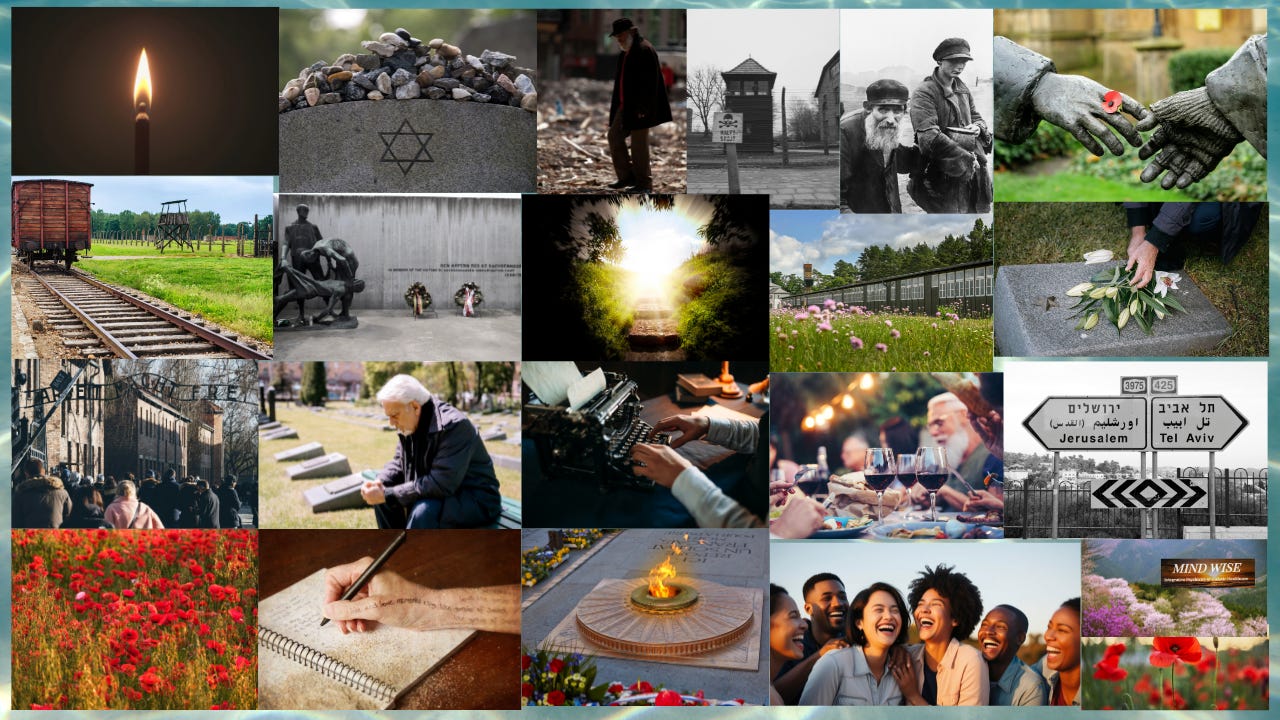
*Click at the bottom of the presentation for a video or audio podcast of the presentation.
My Family’s Journey Through Loss, Reunion, and Remembrance
I recall a poignant personal story I wrote about my reunion with an aged cousin of my mother during a visit to Israel, who was believed lost in a Nazi death camp. Her location was revealed through a letter my mother gave me before her death. The realization now is that it was the deepest and darkest proximity I’ve experienced to the heart of tragedy, human cruelty, and the depravity of others toward humanity, the evilest side of humankind, inflicted on vulnerable people by one of the most sinister forces in the history of our civilization. It also shows the resilience and the beaming forth of the human spirit, and our greatest strength and power to reach the highest state of enlightenment and pure spirit.
As a child in the late 1940s, my mother took me to a local shoe repair shop on Upshur Street in Washington, DC. The shop was near the row-house community where we lived. The struggling shoemaker, among his buzzing machines, appeared to be a quiet, humble man, his face worn by years of struggle and hardship. He had an unfamiliar accent. My mother knew he was from Hungary, where her parents had lived before migrating to this country in the late 1800s. My mother showed him letters she had recently received from a cousin, Iren, her age, whom she had visited as a small child with her mother while seeing their family in Hungary before the war years. I understood that a terrible war had occurred in Eastern Europe, and it was over with the German defeat.
As a child, I only knew that horrible things had happened to the unfortunate people living there, including my mother’s cousin and her family. Her cousin, Iren, was now a refugee from her destroyed home and community, having lost family members. With a voice of despair, the shoemaker in the store translated and read the letters to my mother. He helped write and address my mother’s letters in Hungarian to my mother’s cousin, along with whatever money or goods my mother could send.
My mother was never sure her letters or anything she sent would reach her or get past the authorities or the people providing her refuge. She received the last letter from her cousin after the war had ended, which included her new address in Israel, where she had successfully migrated. The letter expressed hope of seeing my mother in the future. The cousin could reach Israel after her release from a Nazi concentration camp and a brief stay at a refugee center, as one of the few family survivors. The Germans had invaded her hometown in Transylvania near the Hungarian border, destroyed her community, and left her without a place to return to.
No further attempts to make contact were successful. Years later, when my mother could finally travel to Israel, she was terribly disappointed not to find her cousin.
Before my mother died, she gave me the well-kept last letter from Iren, now worn, hoping I would reconnect with her one day. In the mid-eighties, my wife and I traveled to Israel, taking with us the old, worn letter from Iren that my mother had given me before her death. It was my quest to find her, hoping she was still alive. What transpired when we arrived in Israel was a blessing and an inspiration beyond my belief and expectations.
On a sunny, warm day in 1985, in the arid, desert-like landscape, my wife and I walked into the modest hotel lobby near Jerusalem. We were to meet a newfound niece of my mother’s dear cousin. We were young and full of wonder, adventure, excitement, and anticipation that something profound would soon happen.
My mother hoped I would find her beloved cousin and complete the connection she had hoped for since her childhood visit to their European family and their occasional letters thereafter.
Now, Iren’s niece drove us to the rustic lodge where Iren and her husband were staying. I had found Iren’s niece by taking the envelope my mother had given me, with the old address and family name, to a multilingual shop owner. He took time out from his work in his small, stall-like shop to phone twenty or so people with a family name similar to the one on my mother’s envelope. He kept telling our story until Iren’s niece recognized it on one of the calls. The shopkeeper was so sweet to help us, and of course, we bought a few gifts to remember him and his colorful shop.
When we walked into the room, Iren, now in her eighties, appeared slightly frail, with a concentration number tattooed on her arm, beaming with such warmth and a smile that melted our hearts. We all cried and hugged. A profound sense of meaning came with the joining of our hearts and the family’s past. The occasion was also profoundly moving, as we had visited the Holocaust Museum in Jerusalem the day before. There were many reminders of that era’s horrific events, including an exhibit of thousands of children’s shoes belonging to those sent to the crematoriums at the death camps. Some of these children were from my mother’s and Iren’s families.
It was profound to meet Iren, a survivor of one of the worst tragedies in modern history. Iren had not only survived but, as I perceived, had moved to a much higher place of spirituality and love, though she still carried the deep scars of her losses and sacrifices. She had also become an accomplished poet and gave me poems about her Holocaust experience, written in her native Hungarian, in search of meaning in suffering and loss. When I returned to the States, I found a Hungarian professor who translated her poems.
January 27: International Holocaust Remembrance Day
In 2005, the United Nations General Assembly designated January 27th as the International Day of Commemoration in memory of the victims of the Holocaust,1 marking the anniversary of the liberation of Auschwitz-Birkenau. This annual observance serves as a worldwide reminder of the dangers posed by the drift towards rogue and extremist authoritarian rule, hatred, bigotry, and antisemitism. People across the globe are called to remember, reflect, and act to prevent history from repeating itself, with commemorative events held at United Nations Headquarters and offices worldwide.2
What becomes startlingly clear is that the worst of history can repeat itself. A warning to maintain vigilance is evident in the persistence of less visible undercurrents that can build toward a potential recurrence. It is more worrisome when individuals and groups develop a lack of public responsibility and respect for diversity, and show behaviors that suggest a need to control, gain power, and accumulate wealth at the public’s expense. Drift in this direction is clear from both the ideological extremes of the right and the left.
The perpetrators of fear and division gain traction by stoking basic human fears of losing essentials such as livelihoods, economic security, and food and shelter, and of being overrun or replaced by others. Ideologically polarized political parties achieve dominance by espousing disinformation that foments hatred, fear, and division.
Today’s technological advances in communications make it easier for entities seeking an advantage to influence and control, to the point of becoming destructive forces against public welfare. Technology also makes it easier for ill-intentioned people to take advantage of others by manipulating human frailties through deception, rhetoric, and propaganda. The reality is that what occurred in the past can gain momentum and again lead to the degradation of the social fabric, democracy, and the environment essential to health and well-being.
The Enduring Lessons and Warnings from History’s Darkest Chapter
Iren was one of the few in her village and family to survive the Holocaust3 and the Nazi concentration camps, and live to write about the ordeal. Her poems were written from 1944 to 1945, during her last days in her native town of Nagyvarad and as a prisoner at Auschwitz. As Iren wished, her poems are shared to remind everyone never to forget and to watch for any movement toward hatred, division, or a recurrence of the tragic history she had experienced. Her poems offer a poignant reminder of the fate of a democracy that evolves into a brutal, totalitarian, fascist government.
A Haunting Poem from Iren Steier: A Survivor of Auschwitz’s Journey and the Gripping Reality of her Tragic Experience
A translated poem by my mother’s cousin is below: a warning that the poem in its entirety is harsh, graphic, and shocking, but shared because of Iren’s wish to keep people aware that, without vigilance and remembrance of this tragic history, recurrence can become a future reality.
AUSCHWITZ by Iren W. Steier
In a far, strange country, very—very far,
Where maybe the star in the sky is even different,
Where there is no friend, not even the grass,
From where even the flying bird has no message…
A train rumbles into the hell of Polish earth,
It brings wounded, deprived prisoners.
Its doors open, and ten thousand Jews.
are driven into rows — some alive, some dead.
And thousands of Jews are coming, and fall, and fall on and on,
Their unsteady eyes are searching for life.
The prisoners whisper: “ Give them your child!”
Is it possible? — That you save your own life thereby!
I will not give up my child! Never, never, never!
And her two embracing arms clasp it to her bosom.
So they line up, mothers with children
To the great “executioner” — with throbbing hearts.
And the spouses come hand in hand.
But not even a minute—their lives are divided.
I go to the right; he goes to the left — This is life, the other is death.
We are looking on, praying — Whose fate will be what?
Mother, father, brother — Why do I not find them?
Why do they not come with me on this journey?
My eyes stare far — I am looking unsteadily,
Where will my dearest brethren be taken?
Mengele, the executioner, waves here and there,
Who could know that left means death?
If we had known this, we would have gone all there.
Where will we die together with our beloved ones?
And the march is on — to the left — to the road of grief,
Their dearest lives were taken from them…to the gas death!
Where its leprous stomach devoured them continuously.
And drank blood amply to quench its thirst.
And then he danced, devilish dance,
And hung the clanging prisoner’s chain on the living ones.
Within spiked wires, haunted by their hounds,
The “ragged army” — to the right — with eyes cast down…4
Click: For the complete poem and other poems by Iren W. Steier
or go to: https://www.inmindwise.com/p/remembering-the-holocaust?s=w%20s
Tips and Points to Ponder
Prevention is needed to break the recurring cycle of division and hate fueled by ideological and political differences. These cycles are driven by the rise of divisive, authoritarian, and destructive leaders and by the fomenting of age-old animosities toward minorities and targeted groups. Wise and enlightened leaders must rise to the top to foster peace, cooperation, and well-being for the populace. Be informed by history, be more aware, and be active in preventing tragedies from recurring.
Peaceful coexistence can return through a strategic alliance at the highest levels, the positive use of educational programs, and the wise use of artificial intelligence and social media. Dedicated world organizations need to thrive and grow to combat destructive tribalism and selfish interests, recognizing that to exist, we must co-exist and cooperate for everyone’s mutual interest, security, health, and safety.
Support research and resources that promote a better society and advance understanding of the psychology and neuroscience of human behaviors and personalities that drive greed, suppression of others, hatred, violence against minorities, and violence against vulnerable populations. Solutions are needed to provide more adequate resources for those vulnerable to mental health challenges.
More clarity is needed about the impact of misinformation and propaganda on large population segments in our digital age of social media, to prevent misuse by self-serving and promoting entities. The hope is to foster the use of artificial intelligence and social media as tools for a more just, safe, and peaceful coexistence.
For inquiries, go to: https://parksmd.com/scheduling/
I appreciate your interest. Please share with others. Thanks to Shan Parks, editor and project manager, for his valuable contributions and editing. All content is created and published for educational purposes only. It is not a substitute for professional medical services or guidance. Always consult a healthcare provider for care related to medical or mental health conditions. This communication does not provide medical diagnoses, recommendations, treatment, or endorsements.
Thank you!
*For the audio podcast, click here
*For a video podcast of the above presentation, click below:
The United Nations was established after World War II and the Holocaust, events that significantly influenced the changing international human rights principles. The atrocities committed during the Holocaust led in 1948 to two significant documents: the Universal Declaration of Human Rights and the Convention on the Prevention and Punishment of the Crime of Genocide. These documents established a commitment to safeguard human dignity and rights, ensuring the world would never forget the lessons learned from such unimaginable suffering and atrocities.