

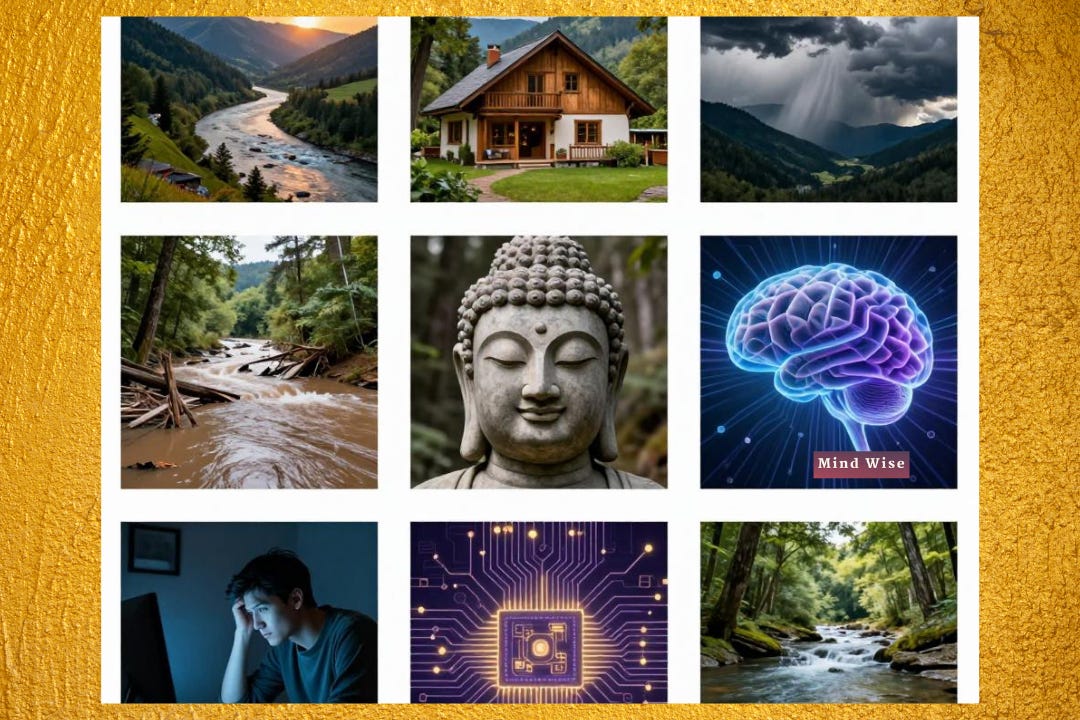
*Click at the bottom of the presentation for a video or audio podcast of the presentation.
Reality speaks—can you adapt—bend without breaking—and again be upright, moving, or swimming with the current, existing in a changed place, or moving in the flow toward a new trajectory?
It has been almost two years since the traumatic experience of living through the devastating Hurricane Helene in September 2024. Western North Carolina has taken time to heal. The bridge outside the River Knoll development entrance has been repaired, allowing traffic to reach the main highway again. Though most families from the 20-plus homes nearest the river have relocated, they are largely awaiting the government’s promised buyout funds, which have been held up and not released by local and federal authorities. This FEMA emergency aid, based on pre-storm home evaluations, will hopefully come soon, after over two years, to help the people with the greatest loss begin anew. All severely damaged properties are now considered in the floodplain, and county, state, and federal authorities are supporting buyouts to level the homes and replace them with green space to reduce future flood risk. The road in the development sustained significant damage but has remained passable with extreme caution, avoiding the riverbank edge and carefully navigating around oncoming cars and trucks.
The 18 homes at higher elevations from the river remain intact, including ours, which stayed out of reach of the ravaging floodwaters. But there is a sense of loneliness and lingering despair, with many of our friends and neighbors gone—the ones we huddled with for days and weeks. We waited for the waters to recede immediately after the storm’s fury, for roads to be repaired so we could get out, and for water and electricity to be restored. Now nature’s greenery and wildlife flourish, as though nothing major happened; life goes on for the trees, forests, squirrels, birds, and bears, who often make their presence known. We are deeply grateful to all the local and national organizations that sent teams and supplies while roads, infrastructure, water, and electricity were being restored. For us, it took a matter of weeks; for others in nearby communities, much longer. We also feel deep gratitude for friends and family who stepped up to provide critical support amid the emotional and financial stress.
Best-laid plans and blindness to guidance from true reality
Before the hurricane, we felt the need to downsize to a smaller living space in a community we thought was better suited to our life stage. A place with more amenities and structured social activities. I realized this more as I had concerns about an older family member and began researching places that might fit his interests and needs. I realized it might be time for my wife and me to consider some of these well-designed settings for ourselves, too. There was also the appeal of returning to the area where I grew up and did most of my medical training. We would be near the family members who mostly stayed in this area. The more my wife and I talked about it, the more a plan took shape, gaining momentum, scaffolding, emotional overtones, details, and even a timeline.
As Asheville, at the time, remained a popular place to move for its beautiful mountains and natural setting, with many recreational opportunities, arts, crafts, and culture, in a Western North Carolina university town, we also thought it was a great time to assess the value of our property and its current worth. We also rationalized that it would be a good time to take on the hard work and stress of downsizing and to go through the demands of putting our house on the market.
The growing narrative in our minds became a top priority, and we put action steps in place with what felt like solid grounding, especially as we researched all the options and consulted people we usually turned to for wise counsel. To show how caught up we were in all that was involved with selling our house and planning a move, my wife, who has periodic bouts of atrial fibrillation, an irregular heart rhythm problem, had a serious recurrence that led to hospitalization for treatment and correction of the arrhythmia. Even with all that, we weren’t deterred and became even more focused on our plans. We rationalized that the area and city we planned to move to had some of the best hospitals and medical care in the country.
A buyer came along, loved our house, and signed a contract to buy it. Things were moving along well; we had finished getting rid of stuff and downsizing—a major, stressful project. We were ready to vacate the house and move into an attractive rental apartment, and we had even signed a lease.
A week or so before closing, we received the shocking news that the buyer wanted to drop out of the contract. They were concerned that an adjacent property might be developed. Then, two weeks later, Hurricane Helene devastated the lower part of our community, making the sale of our property unlikely until our area’s infrastructure, including roads and bridges, could be repaired. See my article about the hurricane and its aftermath.
It was a gigantic wake-up call that the best-laid plans might be incongruent with reality and with our miscalculations and perceptions. It reminded me of a 70s poster I found and put on my wall months before my mother’s sudden death. It was the first major loss in my life, bringing the taste and sting of deep grief that gripped me for weeks and months, and intermittently through the years, showing up in my thoughts and dreams. The words on the poster rang true: “People plan, God laughs.” I didn’t fully grasp its meaning then, but perhaps it was like the statue of a smiling Buddha. I remembered that one of these statues adorned my mother’s table of special gifts. An older brother who had traveled to exotic foreign places gave it to her.
Now I see that the laugh or smile ascribed to the spiritual master, or the nameless one with boundless wisdom, perhaps signifies awareness of human folly, of getting distracted or caught up in our deceptive thinking or silly foibles. It is a reminder not to be so tightly bound to our inner beliefs, expectations, and well-laid plans. Perhaps the Buddha's smile signifies awareness of this human folly. It is a reminder to be more aware and adaptable, to make necessary adjustments to our self-structured, patterned road map of the future—to have the resilience to survive change and loss, to adjust one’s course, or, as in this case, to rewrite one’s script and make discerning choices for a now-realized, less predictable future. The realization reveals the wisdom of being ever mindful of the ever-present potential for dramatic change or loss. Flexibility, acceptance, and the release of tightly held plans, especially the unrealistic ones, are needed, as the dramatic, unanticipated climatic disruption of the usual lovely nature and natural setting we had taken for granted in the picturesque mountains and river valley of Asheville became clear.
What struck me most about this experience was not just that the plan failed, but how completely my mind had constructed an entire world around it — with timeline, emotional investment, and a sense of inevitability that felt like destiny rather than speculation. My wife’s hospitalization didn’t slow us down. The research, the consultations, the lease signing — each step reinforced the narrative until it felt less like a choice and more like reality itself. This is the mind’s great talent and its great vulnerability: it builds futures with such conviction that we forget we are the architects, not the occupants. And I have come to see that this same tendency — to construct, to project, to believe in our own scaffolding — runs straight into the territory of artificial intelligence, which mirrors and amplifies this very human capacity.
The mind tends to get caught up in reasoning and constructing, creating a sense of reality about ourselves and a speculative framework for anticipating a safer, more secure future. Our cognitions form a story or narrative about how things work and the paths we ought to take, as if we were scripted characters in a movie.
We see this in dreams, where elaborate fictional stories sometimes spin off from loose, available ruminations or residues of our waking activities, thoughts, and emotions. Likewise, our mind during wakeful states, if you observe it, is always scheming and constructing elaborate plans or self-pictures of reality, reflecting what we believe or wish for.
This parallels pervasive worry and concern about the rapid proliferation and development of AI. It has been developed using technology that, as the developers found, mirrors how the mind reasons and builds narratives by identifying and reproducing patterns that simulate mental processing. These patterns can influence people’s reasoning and affect behavior, as we see in marketing, advertising, propaganda, and the development of destructive military weapons that destroy human life and the environment.
This parallels pervasive worry and concern about the rapid proliferation and development of AI. It has been developed using technology that, as the developers figured out, mirrors how the mind reasons, builds narratives, and produces patterns that simulate mental processing. These patterns can influence people’s reasoning and affect behavior, as we see in marketing, advertising, propaganda, and in the building of destructive military weapons that destroy human life and the environment.
Artificial intelligence (AI) is destined in the minds of many to be a threat or spoiler of the future, as it is rapidly being developed with untold influence, taking over jobs or manipulating naïve users, leading to dangerous dependence on its use and on information or direction that leads the uninformed or the vulnerable. Receptive audiences are used to serve others’ self-interests and their need for dominance and control. AI has the capacity to shape belief patterns when deployed for commercial or political ends, creating externally imposed patterns, scripting, and planning that drive actions and adverse behaviors.
AI writes scripts based on prompts or inputs from a developer or engineer and, in turn, searches large repositories of information (LLMs, or large language models) to construct responses to requests derived from the vast store of collected data. Common uses include asking for specific information, finding established patterns to create anything from an image to an article, grammar-checking a document, answering questions on a specific topic or research, or suggesting direction or action depending on how the inquiry is phrased.1
Many aspects of AI are making life and work more efficient and easier, especially by expanding our use of ever-growing stores of accumulated knowledge. There is reason to hope that the advances and proliferation of AI across all aspects of our lives will continue to be beneficial. The fear is intensified by daily reporting of the misuse and misapplication of artificial intelligence in industry and government. Because we can fall into complacency and fall behind in our productive mental activity, AI offers a way to greatly extend the reach of our abilities and productivity—though it also carries the potential for misuse, especially in the service of large businesses’ profits and domination, and in the arena of political affairs and warfare. Historically, conflicts have ranged from individuals to tribes to worldwide wars between countries, with outcomes often depending on arsenals of weaponry and control of minds through propaganda and the spread of fear, tapping into people’s primal fear of basic survival.2
Can we leave the discussion with the statue of Buddha smiling at human frailty and missteps to conclude this cautionary tale? This piece ties together a personal account of life events that brought a bit of enlightenment, but what was interesting was how it seemed to run in parallel with, or at least relate to, AI. Artificial intelligence development appears to work well as an aid and extension of our mental functioning and cognition. It clearly influences our beliefs and behavior. Perhaps the coming hurricane-like storm and disruption, with raging rivers and floodwater, is what AI has the potential to be, but will it be like the rivers return to a peaceful flow, with natural order rebalancing and a return to harmony, beauty, and serenity?3
Tips and Points to Ponder
Like our catastrophic thinking and the troubling images that might arise when we look back on dreams and early-morning thoughts, we think about AI in a similar way. The concerns and pessimistic stories in the media and newspapers only amplify our worries. The fears about AI remind me of the old saying: don’t throw out the baby with the bathwater. It relates to some Taoist and Zen philosophy, and perhaps Stoic wisdom as well—to be as present as possible, mindful, and accepting that things change. It reminds us that things don’t always go according to our plans. What happens in reality often shows us that we need to readjust our thinking and expectations—to step out of the bubble of imagination and thought that sometimes traps us in a daydream or detaches us from true reality.
Remaining aware of unfolding events and sensory experiences requires the attention needed to function, protect ourselves, and adapt to life’s demands and the natural environment we are part of. Being alert and informed allows us to plan and make discerning choices about what to act on and what to avoid. With the addition of AI, many amazing things are possible as its capabilities advance. Of course, there are vast concerns and fears about this if it’s left entirely unregulated and falls into the hands of the wrong people or malevolent actors seeking profit, power, and control.
Recently, I was interested in the possibility of downsizing and a potential future move, so I consulted a real estate agent and also ran a series of questions through an AI program on my computer about current market trends, providing it with a lot of details about my property. It came up with very realistic timing for selling and a realistic selling price. Of course, I already had some knowledge beforehand on the subject, so when the AI-generated analysis and information came in, I knew it was roughly accurate and not an AI hallucination or misinformation. AI can make mistakes and be misleading, but it works best when guided by some prior knowledge and education in the subject area being researched or worked with.
The advances are amazing and can surely be a huge help to people, especially if they know how to use them. Of course, the biggest issue for, at least let me say, people like me, is that the AI-assisted computing I did here, in a sense, reinforces my mental processes of figuring, contriving, planning, and creating stronger schemas, stories, or biased projections of what the future will be or what I will over-expect to occur. It distances me from the authenticity of what will actually happen or reveal itself and from the true flow and rhythm of life and nature—I won’t be as mindful of what’s happening in the dynamic now, and I’ll be less prepared to adopt and make adjustments, and I’ll probably be more tense about trying to be in control of things that are realistically not fully predictable or in my control.
As the old Zen Master in a story said, when a series of good and bad things happened to him, students asked what he thought his fate would be with the next event. He could only say, “We will see.” I don’t think this suggests that people shouldn’t keep growing, learning, planning, and making the best choices they can, given that their ideas about the future are only—at best—approximations, since the future is not entirely predictable or knowable. Our limitations are set by human capacity and capabilities, even with the help of the most advanced AI—though it might be able to make better predictions in the future.
I appreciate your interest. Please share this with others. With appreciation to Shan Parks for editorial guidance and project management. All content is created and published solely for educational purposes. It is not a substitute for professional medical services or guidance. Always consult a healthcare provider for care related to medical or mental health conditions. This article does not provide medical diagnoses, recommendations, treatment, or endorsements.
For inquiries, visit parksmd.com/scheduling
Thank you for reading.
*For the audio podcast, click here
*For a video podcast of the above presentation, click below:
My abstract and the linked article below help to better understand AI: In advanced AI applications, bots can function as “AI agents,” personal digital assistants that can use software applications, websites, and other online tools, such as spreadsheets, calendars, and email services. They can both chat and perform tasks. These AI agents are powered by “neural networks,” mathematical systems that learn by analyzing digital data. By detecting patterns in enormous volumes of text gathered from across the internet, these systems can generate text independently—producing outputs ranging from emails and academic papers to computer programs. https://www.nytimes.com/2026/08/31/science/ai-consciousness-agents-email.html?login=smartlock&auth=login-smartlock
Recent articles expressing concern about AI:
https://www.nytimes.com/2026/08/26/technology/bill-gates-ai-risks.html?smid=nytcore-android-share (Bill Gates Is Warning That AI Is More Dangerous Than Big Tech Will Admit);
Prior relevant articles in the Mind Wise blog by Dr. Ron Parks:
https://www.inmindwise.com/p/rapid-ai-growth-the-human-edge-and-bca ;
https://www.inmindwise.com/p/dont-push-the-river-on-losing-and-d3e ;
https://www.inmindwise.com/p/breaking-free-from-stinking-thinking ;
https://www.inmindwise.com/p/the-soul-of-artificial-intelligence
The human brain doesn't forecast reality. It builds predictive labyrinths and moves into them.
When you planned your relocation, negotiated with buyers, and signed a lease, your mind wasn't simply analyzing data. It assembled an elaborate causal simulation. Every confirmed detail acted like an activation boost, locking your cognitive weights into a single, low-entropy trajectory. Then a buyer withdrew, a hurricane altered the river valley, and the entire simulation disintegrated against the physical bedrock.
Generative AI replicates this exact failure mode. We call it prompt compliance or reasoning traces, but under the hood, it's autocatalytic predictive entrapment.
An LLM doesn't possess awareness of the riverbank. It operates inside a closed semantic manifold where high-probability tokens generate the illusion of deterministic logic. If you query an ungrounded model for a real estate forecast or a complex operational pipeline, it doesn't verify physical invariants. It weaves a smooth, frictionless story that aligns with your priors. It gives you the comfort of a map that omits the floodwaters. 🌊
This is why unconstrained AI feels so deceptively competent right before catastrophic failure. It mirrors our own tendency to mistake internal narrative fluency for external physical truth.
The smiling Buddha isn't mocking our ambition. It marks the immutable boundary where human conceptual scaffolding meets unyielding thermodynamic reality. True adaptability demands that we decouple our cognitive state from rigid forward projections and install deterministic verification gates at every step. ⚡
If our minds and our machines are both prone to inventing frictionless futures, what physical anchor in your daily decision loop actually tells you when you're trapped inside your own generated script? 🧭
(ノ*°▽°*)ノ