

“The Tao does nothing, yet nothing is left undone.” Tao Te Ching—Lao-Tzu
*Click at the bottom of the presentation for an audio podcast of the presentation.
I. Here I Am Right Now
There’s a particular fatigue that comes from having too many plans and projects competing for my mind’s attention, all of which seem important to process and either bring to a satisfactory conclusion or let go. That’s where I have been living lately. Unfinished projects and mental schemes stack on top of each other like an unsteady pile of gadgets on my desktop, with my shallow intention to get to them when the time comes. The layering and complexity didn’t arrive all at once. It accumulated like nasty sediment in a pipe until it blocked the water flow.
I hadn’t noticed how my world had become narrower. Somewhere, obscured, were all the things that maybe should have had a higher priority in the thinking space where I spend too much time: the writing that feels alive, the relationships that sustain me, the quiet hour in the morning that used to belong to nothing in particular, and regular physical exercise—whether walking outdoors, at the gym, or swimming. Those things hadn’t disappeared. I’d just deprioritized them, buried them under a structure of my own making, and convinced myself that all my plans and schemes were the reality of my existence.
Then a friend called. They said they’d noticed I hadn’t been writing the articles they usually enjoyed reading. They asked if I was okay. But the call stuck with me. That evening, it stayed with me: the particular kindness of someone noticing my absence from one of the areas of my interests, and my realization that I hadn’t been in touch with my own needs—and that my perspective had perhaps been clouded by my preoccupation with the things that keep our minds busy, strategizing, planning, and scheming.
II. The Dream
The next morning, I woke from a dream that felt unusually real, with a narrative that seemed to unfold as if I were a full participant, carrying over into my waking thoughts and memory. With the dream still fresh, I dictated a note into my Awakening, Thought, Dream Journal before it slipped into the recesses of my memory.
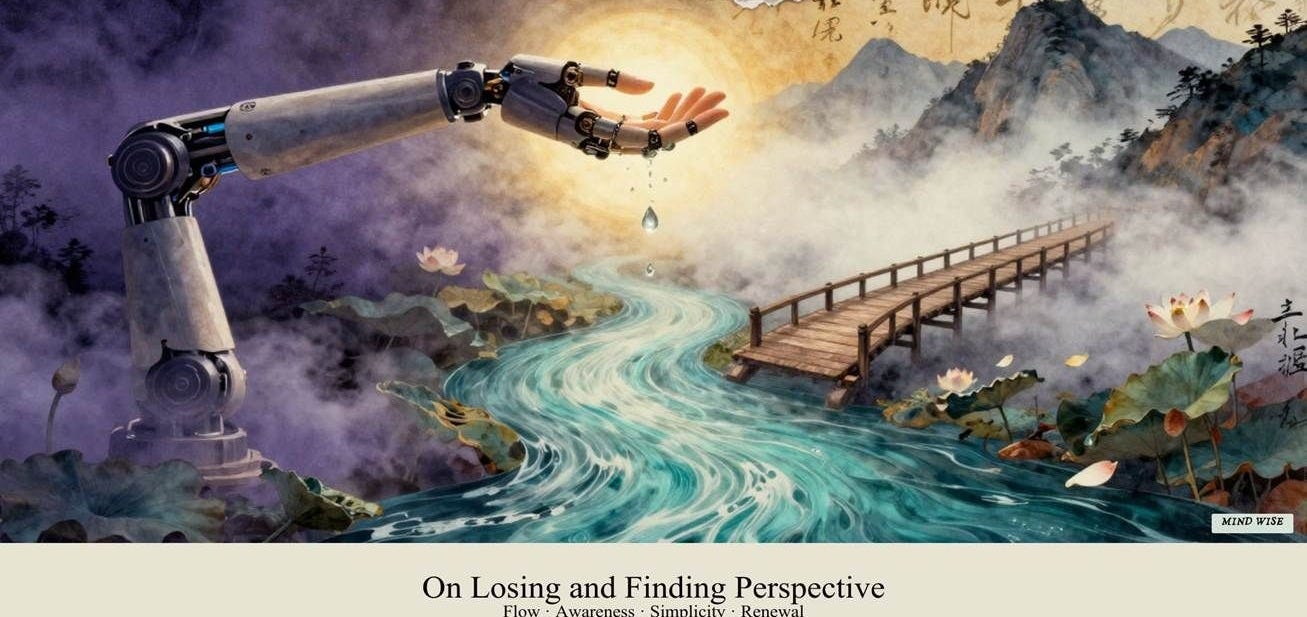
In the dream, I was developing an application for robotic arms, something affordable for the average person. It had an elbow joint and a hand capable of grasping objects that might otherwise be out of reach. I was working across several computer programs, using AI tools that, in my dream, I handled with surprising fluency. The project was nearly complete, and I remember the satisfaction of being close to something that worked, something useful. I could see it functioning in my mind’s eye: the arm extending, the joint bending, the fingers closing around an object and lifting it. The sense of near completion brought a feeling of satisfaction.
And then doubt arrived. I thought the device needed color—something pleasant, like blue or green. I realized I hadn’t named it and couldn’t figure out how to save it properly in the program I was using so others could find and download what I’d made. These weren’t catastrophic problems. They were peripheral concerns: naming, formatting, aesthetics. In the dream, they became an obsession. The project that had been nearly done felt blocked by the need to resolve these few remaining challenges. I was stuck in these final details, circling, unable to move forward or let go.
I woke up surprised by how real it all seemed and how convincing it was—as though the dream’s logic had been airtight and complete. I very much felt like an active participant rather than a passive bystander.
III. The Bridge: Dreams and Waking Plans
I lay there for a while, and the reflection slowly emerged. It wasn’t exactly a new insight, but the dream had given it a shape that now made perfect sense to me. Our waking schemes feel just as real. Our projects, our plans, the timelines we write in notebooks or plot on calendars—they immerse us the same way. We enter them, believe in them, and soon they no longer feel like constructions. They feel like reality itself. And yet they aren’t. They are maps drawn from our current understanding, which is always incomplete. In the dream, I got lost in naming and saving, which seemed essential to the dream story and its reality. The arm was built. It worked. In waking life, I realized, it is not so different.
We layer on related tasks, ancillary goals, and emotional investments in completion for its own sake, until the project becomes more demanding and complex—heavier, more tangled, more anxiety-provoking than anything expected at the beginning. The original purpose recedes. But there is a strong residue of incompleteness, or a loss of purpose and meaning, when a seemingly essential undertaking gets ensnared in obstruction, unrealistic expectations, and the dread of a doomed enterprise.
What struck me most was the continuity. The dream-self and the waking-self were grappling with the same problem—a tendency to become absorbed in detail until the larger picture recedes from awareness—only to return with a dynamic reemergence, often disruptive, an uninvited, trance-breaking intrusion. In the dream, it was the dawn of light and a re-entrance into waking consciousness, a release from the frustration of a dream story going sour.
In my non-dreaming, waking life, it was a friend’s phone call. Both interruptions carried the same quiet message: you may have gone somewhere without realizing it. Be aware and reconnect with the limitations you have inadvertently placed on natural experiencing and its informative guidance. From the awakening comes the gift of new insight, reformulation, and actions to get back in the flow toward a desired outcome. As you are often just a mere participant in any activity or project, a new course correction brings you back into a broader perspective, with the enlightening realization of the larger playing field in which we live and participate.
IV. The Core Problem: Our Grip on Plans
The difficulty, of course, is that we embrace these plans and schemes as our own complex creation, to which we become attached, stifling our possibilities and potential. We set deadlines no one asked us to set, and then we feel the pressure of those deadlines as if they’d been imposed from outside. There’s something almost comical about it—the way we manufacture urgency and then suffer under it as if we had no role in its arrival. But the consequences can be quite real. We exhaust ourselves meeting goals we invented for our chosen projects, and along the way, we lose the capacity to notice whether any of them is still connected to what we actually need or is essential.
The deeper problem is the illusion of control. We plan as though we possess complete knowledge of what’s coming—as though the future is a road we’ve already surveyed and built. The human mind is built to look ahead, anticipate, and prepare. Planning itself is quite natural. What’s destructive is the grip—the tightening of our fingers around a plan until we can’t see or incorporate the new information that arrives constantly and carries great potential benefit.
That information does arrive nonetheless. Reality continuously sends feedback: an unexpected obstacle, a shift in circumstances, a door opening somewhere we hadn’t been looking. But to receive that feedback, we have to be available to it. We have to leave room — perceptual and emotional—for the moment to speak. And when we’re buried in our own elaborate edifice of beliefs and ideas, racing toward a self-imposed deadline, and emotionally invested in outcomes we’ve already decided are necessary, there is no room. The channel is full of our own noise.
What follows is predictable. We miss signals meant for us. The paths we pursue in reality have already begun to close. We hold expectations formed in ignorance of what actually unfolds. When the gap between plan and reality finally becomes too wide to ignore, we may experience it as failure, disappointment, or something that went wrong. Rarely do we trace it back to the moment we tightened our grip, because by then we’ve already moved on to the next item on the to-do list, the next deadline, or the next planned step that adds more complexity or treachery.
V. What Actually Guides Projects
Most projects worth completing are shaped less by their original plan than by what emerges during the process. The unexpected conversation, the obstacle that redirects the work, and the new piece of information that changes the question itself—these make the work more genuine and fruitful. They are the moment-to-moment natural contributors to any project or plan, offering corrections no amount of forethought could have produced.
Adaptability is intelligence in action. It means staying attuned to what’s actually happening rather than to what we assumed would happen, and being willing to change, redirect, or even abandon a direction when the evidence calls for it. This requires something planning doesn’t: acceptance that we don’t know what’s coming, that the plan is provisional, and that letting go of our need for control and micromanaging—it may, in fact, be the conditions under which something genuine can emerge.
The robotic arm in the dream could reach what was out of reach—but only if the hand remained open enough to grasp. It related to what I’d been doing in my waking life: clenching—holding tightly to a structure of projects, deadlines, and self-imposed expectations while the things that actually nourished me waited, patient and unaddressed, just beyond the edge of my narrowed attention.
VI. Don’t Push the River
There’s a phrase that captures this more gracefully, found in Barry Stevens' writings.1 The sentiment and words in her 1970 book have stayed with me: Don’t push the river. It flows by itself. You can float in it, walk alongside it, or exhaust yourself trying to obstruct or change its flow by resisting or pushing against it. The river moves along its own natural path, adapting to the riverbeds and any apparent obstructions along the way. Trying to control or make demands on the river is a total futility, and misdirected effort only leads to exhaustion. To enjoy immersion in water, whether swimming or floating, is to adapt and be present, participating in the experience as it is. Stevens wrote from a background in Gestalt therapy and was deeply influenced by Eastern philosophy, particularly Zen. She framed her writings as an orientation—a way of standing in relation to whatever is unfolding. To push the river is to insist that reality conform to the mental blueprint we hold in mind. To stop pushing is to keep that blueprint or plan provisional, held lightly enough for the present moment to revise it. The meaning is to act from a place where you’re still listening, not so overly committed to your map that you miss what is unfolding in the moment.
I think about this again in relation to the dream. The robotic arm could have performed its function perfectly well without a name, without a particular shade of blue, without a file saved in the exact format that would make it discoverable to strangers. Those details mattered only because I had decided they did. In waking terms, they were the moments when I started pushing because my internal architecture insisted that success required these ornaments.
When working on projects, being in the flow might mean: letting a deadline slide when the work isn’t ready, accepting feedback that contradicts an assumption I’m attached to, or walking away from a conversation that has proven unhelpful. Each release, letting go, or moving on is an act of maintaining the integrity of the work and nurturing the capacity to notice what comes next.
The river or water metaphor also conveys another idea: that movement and adaptability are primary. Whether we’re planning or resting, creating or pausing, we are still moving or flexibly adapting to the larger reality and existence of which we are but a small part. The question is whether we’re moving in harmony with the natural flow of the unfolding process. My friend may have noticed that the quality of my effort had changed, perhaps not in the usual adaptive, life-enhancing, and creative ways that are thought to be most beneficial and sustainable.
VII. The Daoist Thread
Daoist philosophy offers beautiful insights and metaphors. The Dao—sometimes translated as “the Way,” the natural order of things, and sometimes left untranslated because no single word fully captures its meaning. As a philosophy, it’s closer to the observation that everything has a way of moving when not interfered with. Water is a favorite Daoist metaphor. When a river meets an obstacle, it moves around it. Over time, its flow wears through stone, creating a new path. There is intelligence in this movement and flow, marked by responsiveness and acceptance.2
When we move away from this kind of flowing accord, we generate complexity through overzealous or well-intentioned mental contriving or planning. We split things into categories such as success and failure, mine and theirs, planned and unplanned. Each division creates something new to manage, defend, or attach to, out of fear of the consequences of letting go of what we tightly hold. We forget that these formulations are our own constructions and begin to live inside them as if they were real, with walls and restraints. The more elaborate our mental architecture becomes, the harder it is to perceive what is actually here, now, and needing our attention.
What the Daoist tradition gently suggests is that the way back lies in simplicity, such as less planning and self-management, or, as the Daoist expression Wu Wei (non-action/effortless action) captures, in being part of the work without trying to over-control or over-manage. It’s letting our grip relax enough for the present moment to inform us again, as water informs the landscape it touches by arriving fully and, as part of nature, knowing where it can go next. The Tao Te Ching repeatedly speaks of returning to simplicity by shedding the unnecessary so that what remains becomes more apparent and informative. There are invitations to remember that the work itself, and we ourselves, are part of a larger movement that calls for mindfulness and awareness of our presence within a larger work beyond our usual mental perceptions. The challenge is to see whether we’re taking part consciously or unconsciously, whether we’re swimming or sinking, whether we’re pushing against what we can’t control, or whether we’re letting the flow carry us to the destination of greatest benefit.3
VIII. Tips and Points to Ponder
So here I am today, at the desk, finishing my first new article in a while—Don’t Push the River: On Losing and Finding Perspective. The recent calls from friends and a dream seem to kindle the inspiration to get back to writing and attending to my deeper needs and aspirations. One call was a friend’s voice asking if I was okay, and another was a friend sending me a link to a video of her husband excelling in his pursuit of health and longevity. It was a reminder of the priorities I shared with this friend. The issues weren’t really about being too busy. They were about whether I had remembered to live a life that cares about my well-being and that of the planet, and about what I always aspire to write about—a life where I remember the river, moving and trusting that completing the project isn’t the goal. The true mission is to stay aware and mindful of the larger reality beyond what floats around in our limited headspace, to loosen the grip of over-control, to simplify and be in the natural flow of life, and to be open to change with adaptability and acceptance. 4
I can’t help but recall, while writing this, the traumatic experience I had when the hurricane devastated Asheville and our community on September 26, 2024.5 Heavy rainfall and winds caused the Swannanoa River to rise to nearly thirty feet. It wreaked havoc, destroying many homes at the base of our community, while the upper community where I live took in homeless families, all of whom survived several weeks without electricity or the convenience of running water. The river overflowed its banks with the excess rain, and to get around obstructions, it became a massive lake at the expense of the homes in the floodplain. Residents were acutely aware of the evolving devastation and, with dread and trauma, adapted and moved to or stayed on higher ground. Houses were lost, and one person drowned on the other side of the river after misjudging and going back to their dwelling to retrieve belongings. But all others in our community survived and made it to higher ground. All damaged homes in the lower part of the community that remain in the floodplain are being demolished and converted into green space, and the river now flows peacefully in its new path, well within its banks. We’re very much a participating part of nature, for better or worse, with a call for awareness and for being in flow with life and its events, adopting and being in touch with the greater reality as it unfolds, as best we can.
For inquiries, go to: https://parksmd.com/scheduling/
I appreciate your interest. Please share with others. Thanks to Shan Parks, editor and project manager, for his valuable contributions and editing. All content is created and published for educational purposes only. It is not a substitute for professional medical services or guidance. Always consult a healthcare provider for care related to medical or mental health conditions. This communication does not provide medical diagnoses, recommendations, treatment, or endorsements.
Thank you!
*For the audio podcast, click here

Barry Stevens, Don’t Push the River (It Flows by Itself) (Real People Press, 1970)—Barry Stevens (1902–1985) was an American writer and Gestalt therapist, known for her work with Fritz Perls. Her writing captures the spirit of flowing rather than forcing.
The Way of Zen by Alan Watts (1957)—Wrote about how Daoism and Buddhism influenced each other and helps understand Western interpretations of Eastern philosophy. “Tao: The Watercourse Way” by Alan Watts, published posthumously in 1975 by Pantheon Books. All the books and writings I had the chance to read were thoroughly engaging, enjoyable, and informative.
Tao Te Ching—attributed to Lao-Tzu—is the central classic of Daoism. Short, poetic, and intentionally elusive, it has been translated many times. An expression from the Daoist—Wu Wei (non-action/effortless action)—captures some of the essence of the philosophy.
Article by Dr. Parks - Embracing Life’s Natural Rhythm: https://www.inmindwise.com/p/embracing-lifes-natural-rhythm-for
Article by Dr. Parks - Hurricane Trauma Comes to Idyllic Asheville: https://www.inmindwise.com/p/hurricane-trauma-comes-to-idyllic